Friday, 11 May 2018
Microbiology Semester 2 Week 11
Assalamualaikum and hi everyone... how are you all? I hope everyone will be fine as well... On Tuesday, there is no microbe class because some are went to the hometown for voting. On Friday, once the Pakatan Harapan win the government election. Therefore, Public holiday for 2 days which is on Thursday and Friday.

Friday, 4 May 2018
Microbiology Semester 2 Week 10
Assalamualaikum and hi everyone... how are you all? I hope everyone will be fine as well... On Tuesday, there is no class because of the labour day.
On Friday, my classmates Fakhrul, Wani, Sabrina, Firdaus, Wem Ying, Maziatul, and Jia Shin was presented about a microbe based on topics provided to them. The program is known as Pecha Kucha. Fakhrul talked about Lactobacillus acidophilus, and other also presented according to their topics which is Fakhrul and Jia Shin are food field, Firdaus and Maziatul Husna are biotechnology field, Sabrina is pharmaceutical and neutraceutical field, Wem Ying is agriculture field and lastly Izwani is environment field.
That's all from this week!!!
On Friday, my classmates Fakhrul, Wani, Sabrina, Firdaus, Wem Ying, Maziatul, and Jia Shin was presented about a microbe based on topics provided to them. The program is known as Pecha Kucha. Fakhrul talked about Lactobacillus acidophilus, and other also presented according to their topics which is Fakhrul and Jia Shin are food field, Firdaus and Maziatul Husna are biotechnology field, Sabrina is pharmaceutical and neutraceutical field, Wem Ying is agriculture field and lastly Izwani is environment field.
That's all from this week!!!
Microbiology Semester 2 Week 9
Assalamualaikum and hi everyone... how are you all? I hope everyone will be fine as well... On Tuesday, before our class start, my classmates Hamdi, Faizatul Aina and Yoga was presented about a microbe based on topics provided to them. Later on, Dr. Suriana taught us about the mutation. Basically, Mutation is any inheritable change in the base sequence of DNA. A strain carrying such a change is mutant. Mutant differ from parental strain (wild-type stain) in genotype (precise sequence of nucleotides) and phenotype (observable properties). Mutation leads to three possibilities which is silent mutation is no phenotypic change, beneficial mutation is new and enhanced property and harmful mutation is negatively effect functionality of proteins. Causes of mutations can be of two
categories which is spontaneous mutation is not caused by mutagen example is errors in during gene expression and as a result of a natural radiation alters the structure of bases in the DNA and induced mutation is caused by chemical or physical agents.
Type of mutation have two types which is point mutation and frameshift mutation. Point mutation is base substitutions at one point in the DNA or RNA sequence. Three types of point mutation which is silent mutation, nonsense mutation and missense mutation. Silent mutation is genetic code is degenerate or redundant because a single amino acid may be coded for by more than one codon and not all mutation in protein-encoding genes result in changes in protein. Silent mutation is almost always occur in the third base of a codon (except, arg and leu- at first base). Missense mutations is changes in first or second base lead to significant changes in protein and instead of the original amino acid in the polypeptide chain, a different one is substituted. Nonsense mutations is results from stop codon (UAG, UAA, UGA) formation, change from codon for an amino acid (sense codon) to a stop codon (nonsense codon) and termination of translation. Frameshift mutation is genetic code is read from one end in conservative blocks of 3 bases, mutations that add or remove a base shift the reading frame of the genetic message results in a totally different protein from the point of mutation. Most likely to get termination of protein synthesis soon after the mutation. Type of mutagen is base analogues, chemical mutagens, radiation and intercalating agents. Identifying mutants is detection by selecting or testing for an altered phenotype. Two kind of identifying mutant which is selectable or nonselectable. Nonselectable is loss of colour in pigmented organism. Selectable is drug resistance; an antibiotic-resistant mutant can grow in the presence of antibiotic concentrations that inhibit or killed the parent.
On Friday, Dr Suriana taught us about the gene recombination. Genetic Recombination is exchange of genes between two DNA molecules and forms new combination of genes on a chromosome. Types of Genetic Transfer which is vertical gene transfer and horizontal gene transfer. Vertical gene transfer is occurs during reproduction, between generations of cells. Horizontal gene transfer is transfer of genes between cells of the same generation. Mechanisms of Horizontal Transfer Genes are naturally transferred between bacteria using three mechanisms which is transformation, transduction and conjugation. Transformation is transfer of naked DNA from one bacterium to another, works best when donor and receipt are closely related and recipient has to be competent. Competence is the ability of a cell to receive naked DNA from its environment which is alterations in the cell wall that make it permeable to large NDA molecules and some bacteria are naturally competent but some have to undergo treatment to make it competent. Two types of competent which is natural competence and artificial competence . Discovered by Fredrick Griffith in 1928 while working with Streptococcus pneumoniae. Transduction is the bacterial DNA transferred from donor to recipient via bacteriophage. Bacterial DNA is incorporated into bacteriophage. Two types of transduction which is generalized is any bacterial genes are transferred and specialized is specific regions of DNA are transferred.
Conjugation requires direct contact between cells. Types of contact is Gram negative is the sex pili and Gram positive is the sticky surface molecule. Mediated by plasmids can code for traits that give bacteria advantage. Plasmid types is fertility factor, dissimilation plasmids, resistance factor, bacteriocin factor and virulence plasmids. 2 kinds which is Plasmid transfer and Chromosome transfer. Plasmid transfer is F+ donor contains F plasmid is F - recipient cells do not contain F plasmid and sex pilus is formed.Oone strand of DNA is transferred into the recipient cell from the donor cell and F - become F +. Chromosome transfer is when F plasmid is integrated into the chromosome, an Hfr cell is formed. Hfr has high frequency recombinant during conjugation, an Hfr cell can transfer chromosomal DNA into the recipient cell (F- ) is usually the chromosome breaks before it is fully transferred. F - become recombinant F- cell. Transposons is small segments of DNA that can move from one region of a chromosome to another region of the same chromosome or to a different chromosome or DNA molecule is found in chromosomes, plasmids, viruses. It has simple to complex structures and can carry any type of gene, including antibiotic resistance genes that cause mutations which is increase (or decrease) the amount of DNA in the genome.


categories which is spontaneous mutation is not caused by mutagen example is errors in during gene expression and as a result of a natural radiation alters the structure of bases in the DNA and induced mutation is caused by chemical or physical agents.
Type of mutation have two types which is point mutation and frameshift mutation. Point mutation is base substitutions at one point in the DNA or RNA sequence. Three types of point mutation which is silent mutation, nonsense mutation and missense mutation. Silent mutation is genetic code is degenerate or redundant because a single amino acid may be coded for by more than one codon and not all mutation in protein-encoding genes result in changes in protein. Silent mutation is almost always occur in the third base of a codon (except, arg and leu- at first base). Missense mutations is changes in first or second base lead to significant changes in protein and instead of the original amino acid in the polypeptide chain, a different one is substituted. Nonsense mutations is results from stop codon (UAG, UAA, UGA) formation, change from codon for an amino acid (sense codon) to a stop codon (nonsense codon) and termination of translation. Frameshift mutation is genetic code is read from one end in conservative blocks of 3 bases, mutations that add or remove a base shift the reading frame of the genetic message results in a totally different protein from the point of mutation. Most likely to get termination of protein synthesis soon after the mutation. Type of mutagen is base analogues, chemical mutagens, radiation and intercalating agents. Identifying mutants is detection by selecting or testing for an altered phenotype. Two kind of identifying mutant which is selectable or nonselectable. Nonselectable is loss of colour in pigmented organism. Selectable is drug resistance; an antibiotic-resistant mutant can grow in the presence of antibiotic concentrations that inhibit or killed the parent.
On Friday, Dr Suriana taught us about the gene recombination. Genetic Recombination is exchange of genes between two DNA molecules and forms new combination of genes on a chromosome. Types of Genetic Transfer which is vertical gene transfer and horizontal gene transfer. Vertical gene transfer is occurs during reproduction, between generations of cells. Horizontal gene transfer is transfer of genes between cells of the same generation. Mechanisms of Horizontal Transfer Genes are naturally transferred between bacteria using three mechanisms which is transformation, transduction and conjugation. Transformation is transfer of naked DNA from one bacterium to another, works best when donor and receipt are closely related and recipient has to be competent. Competence is the ability of a cell to receive naked DNA from its environment which is alterations in the cell wall that make it permeable to large NDA molecules and some bacteria are naturally competent but some have to undergo treatment to make it competent. Two types of competent which is natural competence and artificial competence . Discovered by Fredrick Griffith in 1928 while working with Streptococcus pneumoniae. Transduction is the bacterial DNA transferred from donor to recipient via bacteriophage. Bacterial DNA is incorporated into bacteriophage. Two types of transduction which is generalized is any bacterial genes are transferred and specialized is specific regions of DNA are transferred.
Conjugation requires direct contact between cells. Types of contact is Gram negative is the sex pili and Gram positive is the sticky surface molecule. Mediated by plasmids can code for traits that give bacteria advantage. Plasmid types is fertility factor, dissimilation plasmids, resistance factor, bacteriocin factor and virulence plasmids. 2 kinds which is Plasmid transfer and Chromosome transfer. Plasmid transfer is F+ donor contains F plasmid is F - recipient cells do not contain F plasmid and sex pilus is formed.Oone strand of DNA is transferred into the recipient cell from the donor cell and F - become F +. Chromosome transfer is when F plasmid is integrated into the chromosome, an Hfr cell is formed. Hfr has high frequency recombinant during conjugation, an Hfr cell can transfer chromosomal DNA into the recipient cell (F- ) is usually the chromosome breaks before it is fully transferred. F - become recombinant F- cell. Transposons is small segments of DNA that can move from one region of a chromosome to another region of the same chromosome or to a different chromosome or DNA molecule is found in chromosomes, plasmids, viruses. It has simple to complex structures and can carry any type of gene, including antibiotic resistance genes that cause mutations which is increase (or decrease) the amount of DNA in the genome.
Saturday, 21 April 2018
Microbiology Semester 2 Week 8
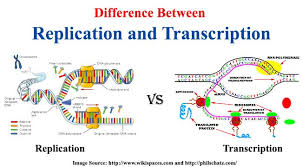
Assalamualaikum and hi everyone... how are you all? I hope everyone will be fine as well... On Tuesday, before our class start, my classmates Amyza, and Nisha was presented about a microbe based on topics provided to them. Later on, Dr. Suriana taught us about Microbial Genetics. Basically, DNA Replication is a process by which a double-stranded DNA molecule is copied to produce two identical DNA molecules. The process of the genetic code duplicated and passed on to each offspring. Must be completed during a single generation time. Elongation and Termination of the Daughter Molecules, as replication proceeds, the newly produced double strand loops down, DNA polymerase I removes RNA primers and replaces them with DNA and when the forks come full circle and meet, ligases move along the lagging strand which begin initial linking of the fragments and complete synthesis and separation of the two circular daughter molecules.
Transcription is process by which the information in a strand of DNA is copied into a new molecule of messenger RNA (mRNA). mRNA is comparable to a copy from a reference book because it carries the same information as DNA but is not used for long-term storage and can freely exit the nucleus. Although the mRNA contains the same information, it is not an identical copy of the DNA segment, because its sequence is complementary to the DNA template. Transcription is carried out by an enzyme called RNA polymerase and a number of accessory proteins called transcription factors. Transcription factors can bind to specific DNA sequences called enhancer and promoter sequences in order to recruit RNA polymerase to an appropriate transcription site. Together, the transcription factors and RNA polymerase form a complex called the transcription initiation complex. This complex initiates transcription, and the RNA polymerase begins mRNA synthesis by matching complementary bases to the original DNA strand. The mRNA molecule is elongated and, once the strand is completely synthesized, transcription is terminated. The newly formed mRNA copies of the gene then serve as blueprints for protein synthesis during the process of translation. The copying is along the same lines as already explained, (A for T, G for C, C for G) except that a different base called U (uracil) replaces T (thymine).
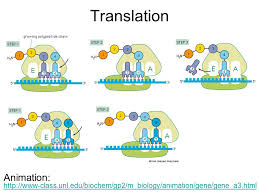
On Friday, before our class start, my classmates Sayyi, Shafiqah, Aqilah and I was presented about a microbe based on topics provided to them. I was presented about the Chlorella vulgaris. Later on, Dr Suriana taught us about translation and Gene Regulation. Translation process by which a protein is synthesized from the information contained in a molecule of messenger RNA (mRNA). During translation, an mRNA sequence is read using the genetic code, which is a set of rules that defines how an mRNA sequence is to be translated into the 20-letter code of amino acids, which are the building blocks of proteins. Ribosome is a factory of protein synthesis. Three steps of Translation which is chain initiation is assembly of ribosome, mRNA start codon, and initiator tRNA anticodon. Chain Elongation is ribosome moves codon-by-codon and codon-anticodon pairing results in the
formation of specific amino acids chain, polypeptide. Chain Termination is when the ribosome reaches stop codon, polypeptide is released and translation complex disassembles.
Gene regulation is mechanisms to increase or reduce production of RNA or protein because energy conservation, environmental adaptation and enzyme activity regulation. Regulation can occur during different stages of gene expression which is transcriptional regulation, translational regulation and post-transcriptional or posttranslational regulation. Regulation of Gene Expression which is gene expression refers to the combined process of transcription and translation of genetic information to a functional protein, not all genes are expressed at any one time, nor are they always expressed at the
same level. Gene expression is tightly regulated, or controlled, so that the cell only makes the gene
products that it needs for efficient growth under its current environmental conditions. An operon is regulatory protein binding region and downstream gene(s). Regulatory proteins called repressors or activators act as off and on switches for transcription, respectively. Negative regulation involves repressor proteins that respond to cell conditions so to actively repress (prevent) RNA Polymerase from beginning transcription of the gene (or operon) by binding onto the DNA at the operator site. Positive regulation of transcription also can occur. Here, environmental conditions in the cell causes an activator protein to bind to the promoter site for a gene (or operon), which enables RNA Polymerase to begin transcription. Operon is a group of genes that consists of Promoter is region where RNA polymerase initiates transcription, Operator is region adjacent to structural genes
that controls their transcription and Structural genes is genes with related functions.
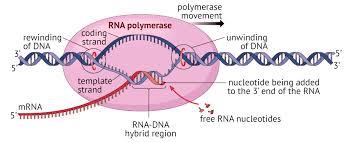


Transcription is process by which the information in a strand of DNA is copied into a new molecule of messenger RNA (mRNA). mRNA is comparable to a copy from a reference book because it carries the same information as DNA but is not used for long-term storage and can freely exit the nucleus. Although the mRNA contains the same information, it is not an identical copy of the DNA segment, because its sequence is complementary to the DNA template. Transcription is carried out by an enzyme called RNA polymerase and a number of accessory proteins called transcription factors. Transcription factors can bind to specific DNA sequences called enhancer and promoter sequences in order to recruit RNA polymerase to an appropriate transcription site. Together, the transcription factors and RNA polymerase form a complex called the transcription initiation complex. This complex initiates transcription, and the RNA polymerase begins mRNA synthesis by matching complementary bases to the original DNA strand. The mRNA molecule is elongated and, once the strand is completely synthesized, transcription is terminated. The newly formed mRNA copies of the gene then serve as blueprints for protein synthesis during the process of translation. The copying is along the same lines as already explained, (A for T, G for C, C for G) except that a different base called U (uracil) replaces T (thymine).
On Friday, before our class start, my classmates Sayyi, Shafiqah, Aqilah and I was presented about a microbe based on topics provided to them. I was presented about the Chlorella vulgaris. Later on, Dr Suriana taught us about translation and Gene Regulation. Translation process by which a protein is synthesized from the information contained in a molecule of messenger RNA (mRNA). During translation, an mRNA sequence is read using the genetic code, which is a set of rules that defines how an mRNA sequence is to be translated into the 20-letter code of amino acids, which are the building blocks of proteins. Ribosome is a factory of protein synthesis. Three steps of Translation which is chain initiation is assembly of ribosome, mRNA start codon, and initiator tRNA anticodon. Chain Elongation is ribosome moves codon-by-codon and codon-anticodon pairing results in the
formation of specific amino acids chain, polypeptide. Chain Termination is when the ribosome reaches stop codon, polypeptide is released and translation complex disassembles.
Gene regulation is mechanisms to increase or reduce production of RNA or protein because energy conservation, environmental adaptation and enzyme activity regulation. Regulation can occur during different stages of gene expression which is transcriptional regulation, translational regulation and post-transcriptional or posttranslational regulation. Regulation of Gene Expression which is gene expression refers to the combined process of transcription and translation of genetic information to a functional protein, not all genes are expressed at any one time, nor are they always expressed at the
same level. Gene expression is tightly regulated, or controlled, so that the cell only makes the gene
products that it needs for efficient growth under its current environmental conditions. An operon is regulatory protein binding region and downstream gene(s). Regulatory proteins called repressors or activators act as off and on switches for transcription, respectively. Negative regulation involves repressor proteins that respond to cell conditions so to actively repress (prevent) RNA Polymerase from beginning transcription of the gene (or operon) by binding onto the DNA at the operator site. Positive regulation of transcription also can occur. Here, environmental conditions in the cell causes an activator protein to bind to the promoter site for a gene (or operon), which enables RNA Polymerase to begin transcription. Operon is a group of genes that consists of Promoter is region where RNA polymerase initiates transcription, Operator is region adjacent to structural genes
that controls their transcription and Structural genes is genes with related functions.
Thursday, 12 April 2018
Microbiology Semester 2 Week 7
Assalamualaikum and hi everyone... how are you all? I hope everyone will be fine as well... On Tuesday, before our class start, my classmates Aina, Amira and Adriana was presented about a microbe based on topics provided to them. The program is known as Pecha Kucha. Aina talked about Karlodinium veneficum, Amira talked about Haematococcus phuvalis, and Adriana talked about Clostridium noyvi. Later on, Dr. Suriana taught us about introduction of systematic prokaryotes again because on friday before mid sem break, many students are absent to the class. Dr. Suriana also taught us about small-subunit rRNA-based classification of prokaryotes. Molecular method for systematics which is molecular methods have been introduced, based on sequencing of genes that can be used as “evolutionary clocks,” i.e., that provide information on evolution in the prokaryote world, the principle of molecular taxonomy and of phylogenetic tree reconstruction is based on the concept that biological macromolecules can be used as evolutionary chronometers that measure evolutionary change and thanks to the availability of new techniques i.e sequencing of the genes encoding the small-subunit (16S) ribosomal RNA. Discovery of small-subunit ribosomal RNA sequence which is Carl Woese, in the late 1970s, hypothesized that ribosomes were ancient, conserved structure, better way to check is by looking at the genetic sequence. He studied various ribosomal RNAs: 5S, 16S and 23S, and finally chose 16S as molecule to study the evolution of life.
Properties of rRNA as phylogenetic marker is common ancestry, genetic stability, appropriate size and presence of independently evolving domains. The phylogenetic tree is do not provide an answer to the question of the nature of the universal ancestor of all life forms on Earth, do not infer from these trees whether the Archaea are a more ancient group than the Bacteria, or whether the prokaryotes formed an ancestral stage that led to the development of the primitive eukaryotic cell, mitochondria found in most eukaryotic cells have an ancestry that can be traced back to the Proteobacteria and origin of the chloroplasts in algae and higher plants, is within the Cyanobacteria. Differences between Bacteria and Archaea is the morphologically, the Archaea and the Bacteria are very similar, and also at the level of the cell ultrastructure, there are no obvious differences between typical representatives of both groups.
Differences is in the nucleotide sequences of ribosomal RNAs, structure of the cell wall, type of lipids in the membrane, the properties of the transcription mechanism of DNA to form RNA, the details of operation of the protein synthesis machinery of the ribosome, sensitivity to different antibiotics. Identification of prokaryote isolates not a simple procedure, not straightforward conventional way using the dichotomous identification keys, latest approach using polyphasic approach to taxonomy – morphological characters (cell shape and size, the Gram-reaction, cell inclusions, presence and nature of the surface layers, including extracellular capsules). Polyphasic approach morphological characters – (cell shape and size, the Gram-reaction, cell inclusions, presence and nature of the surface layers, including extracellular capsules), information on motility – (presence of flagella, their number and the way they are inserted into the cell, gliding movement), the mode of nutrition and energy generation, the cells’ relationship to molecular oxygen, temperature, pH, and tolerance towards and requirement for salt.
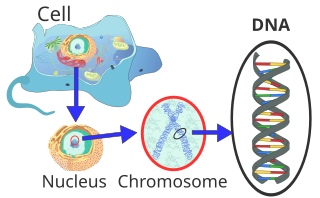
On Friday, before our class start, my classmates Subatra, Nadhirah and Harissa was presented about a microbe based on topics provided to them. The program is known as Pecha Kucha. Subatra talked about Ceriporiopsis subvermispora, Nadhirah talked about Penicillium chrysogenum, and Harissa talked about Agaricus bisporus. Later on, Dr. Suriana taught us about microbial genetic. The genome is all genetic instructions (genes) for development of cellular structures, metabolic functions, and their regulation (organization of which, when, where, and how much). Genes are located within chromosomes (linear or circular) or plasmids, as specific regions of DNA (or RNA for some viruses). Gene a certain segment of DNA that contains the necessary code to make a protein or RNA molecule.



Subscribe to:
Posts (Atom)
Microbiology Semester 2 Week 14
Assalamualaikum and hi everyone... how are you all? I hope everyone will be fine as well... On Tuesday, before our class start...

-
Assalamualaikum and hi everyone... how are you all? I hope everyone will be fine as well... On Tuesday, before our cla...
-
 Assalamualaikum and good afternoon eveyone that reading my blog now.... 😃😃😃😃. This week is my forth week of microbiology class. I fee...
 -
Assalamualaikum and hi everyone... how are you all? I hope everyone will be fine as well... On Tuesday, before our class start, my ...

